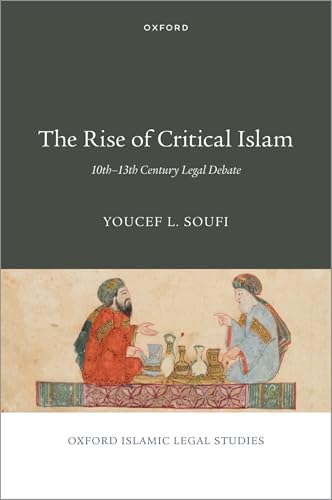
The Rise of Critical Islam: 10th-13th Century Legal Debate
Material type: TextSeries: Oxford Islamic Legal StudiesPublication details: New York: Oxford University Press, 2023Description: 274 p., 24 cmISBN:
 - 9780197685006
- Abū Isḥāq al-Shīrāzī Abū Isḥāq Ibrāhīm ibn ʿAlī al-Shīrāzī
- Islamic law -- History
- Islamic law -- Methodology -- History
- Islamic legal culture -- Munazara (disputation) -- Oral debates -- 10th-13th century
- Islamic law -- Institutional conditions -- Social conditions -- Discursive conditions -- 10th century-13th century
| Cover image | Item type | Current library | Home library | Collection | Shelving location | Call number | Materials specified | Vol info | URL | Copy number | Status | Notes | Date due | Barcode | Item holds | Item hold queue priority | Course reserves | |
|---|---|---|---|---|---|---|---|---|---|---|---|---|---|---|---|---|---|---|
 Books
Books
|
Netherlands-Flemish Institute in Cairo (NVIC) Library Main Library - 0.01 | B 1676 (Browse shelf(Opens below)) | Available | B 1676 |
Part I -- Chapter 1: Mourning Loss Through Debate: Pious Critique and its Limits -- Chapter 2: The Emergence of Pious Critique: a Genealogy of "Munazara" -- Chapter 3 "Why do We Debate?": Uncovering Two Discursive Foundations for Disputation -- Part II -- Chapter 4: Debating the Convert's Jizya: How the Madhhab Enabled Ijtihad -- Chapter 5: Forced Marriage in Shafi'i Law: Revisiting School Doctrine -- Chapter 6: The Case of the Mistaken Prayer Direction: Debating Indeterminate School Doctrine -- Part III -- Chapter 7: The End of Critical Islam?: Shafi'ism and Temporal Decay
"In a richly narrated historical study, Soufi excavates an Islamic legal culture of critique from the 10th-13th century. Focusing on the practice of (disputation), Soufi explores how and why oral debates became a pervasive and revered part of the intellectual legal landscape of Iraq and Persia. Pushing back against claims that classical Muslim jurists sought to weed out differences of opinion, The Rise of Critical Islam presents a community committed to the openness, fluidity, and continued exploration of the law. In uncovering this classical legal culture, Soufi invites readers to question claims about the promise of secular critique in disciplining religious passions and forging human solidarity." --Provided by publisher.
There are no comments on this title.